
Intelligence
Get up to speed in minutes, not hours.
- Hospitals, clinics, pharmacies, fire and EMS, air ambulances and rescue helicopters
- Weather, terrain, toxic plants and venomous creatures
- State EMS regulations and the ICS-206 Medical Plan
For wildland fire medical units
Faster intelligence, streamlined documentation, live resource tracking — built on tools resources already use.
This project is supported by John from Watch Duty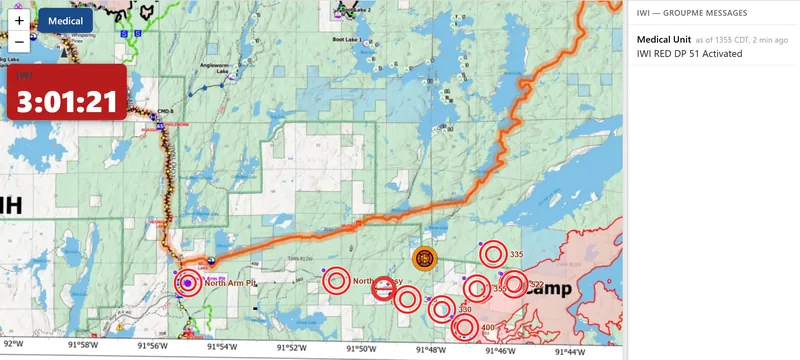
What it does
From the first hour of an assignment to the last document filed, the medical unit works from the same information.
Get up to speed in minutes, not hours.
Enter it once. It flows everywhere.
Supports 10 customizable digital document templates, with more on the way. Templates automate document generation, speeding work and reducing errors.
See every medical resource at a glance.
How it works
Choose an existing fire or a location and run the intelligence report.
Arriving medical resources enter their own information from a link or QR code. Medical plans, glide path, credential verification, documentation all source from the same records.
Group texts and satellite texts update the live map, the accountability board and the unit log. Real-time tracking available.
Rapidly verify credentials, generate and file required documentation. Streamlines inspections, tactics, evaluations, extensions and more.
Built for the whole fire community
The more medical units that use Incident Automation, the more everyone gains.
Rapid identification of medical and safety trends across the wildland fire environment.
Shared, collaborative maintenance of an increasingly trustworthy database of hospitals, clinics, pharmacies, air ambulances and rescue helicopters, fire and EMS, dispatch and coordination centers, and regulatory information.
On the horizon Planned integrations with DART, flight tracking, e-ISuite, IROC and Microsoft tools. See planned integrations →
The founder
Nick Arnett, founder of Incident Automation, brings an unusual combination of fire and EMS experience and software intelligence product experience. He is a Captain with the Mi Wuk Sugar Pine Fire Protection District in Tuolumne County, California, with two decades of fire service experience in volunteer and paid roles, and a primary Medical Unit Leader on Southern Area Complex Incident Management Team 1. He is also a Public Information Officer, Fireline EMT and Critical Incident Stress Manager.
Between his careers as a paramedic and in the fire service, Nick worked in journalism, market research, and software product innovation and management. His focus was search and other intelligence applications, for clients and customers including the White House, the CIA, the NSA and other government agencies. He co-founded two social media intelligence startups, including SentiMetrics Partners, which was acquired by Liveworld Inc.
His certifications span a broad range of fire and rescue disciplines, including Rope Rescue Technician, Large Animal Rescue Technician, Wilderness EMT and Community Wildland Fire Mitigation. He is a credentialed instructor through California State Fire Training (Instructor I and II), the National Volunteer Fire Council’s Wildland Fire Assessment Program, the California Specialized Training Institute and the International Critical Incident Stress Foundation.
He has taught as a boarded instructor at the South Bay Regional Public Safety Academy and in the NWCG Medical Unit Leader course and California’s Fireline EMT/Paramedic and Cancer/Behavioral Awareness courses, and has logged hundreds of hours as a CERT instructor for cities across the Bay Area.
He also brings deep expertise in firefighter health, wellness and resilience. For more than 20 years he has taught crisis intervention and peer support to local, state and federal public safety agencies, and he has responded to more than 1,000 crisis support assignments with the Bay Area Crisis Response Team, CAL FIRE’s Employee Support Services, the USDA Forest Service, and as a contractor to numerous agencies. He is a chaplain with the California Fire Chaplain Association and the author of six books, including Stress Into Strength (HarperCollins Leadership, 2021) and the most widely used public safety pocket guide for crisis intervention.
Get started
Request access for your medical unit, or sign up to hear about upcoming introduction and overview sessions.
Sign up for updates, including upcoming introduction and overview sessions